

This post contains affiliate links. If you click and buy, I may earn a commission at no extra cost to you. I only recommend brands and products that I personally trust and believe in.
Let me be honest with you: if you’ve been following my Ultimate Beginner’s Running Guide and step-by-step starting plan, you’re probably discovering what I learned the hard way – getting started is only half the battle.
The other half? Showing up consistently when your brain gives you a hundred reasons not to.
Maybe you’ve nailed the run-walk intervals. Maybe you’ve got your gear sorted and you’re sticking to three runs per week. But then comes that morning when your alarm goes off and every fiber in your body says “not today.”
I’ve been there more times than I can count. Days when my running gear sat folded on the dresser, judging me. Days when I’d rather organize my sock drawer than step outside for a run.
But here’s what I’ve learned through trial and plenty of missed runs: staying consistent isn’t about feeling motivated every single day. It’s about having a mental toolkit that works when motivation doesn’t show up.
This guide covers the mental strategies that helped me stay consistent, even when running felt like the last thing I wanted to do – and how you can build the same mental resilience in your own running journey.
1. The Motivation Myth
Table of Contents
ToggleHere’s something that took me way too long to understand: .
We’ve been taught to wait for the right feeling, the perfect moment, the surge of energy that makes us want to run. But that’s backwards thinking – and it’s why so many people give up after their initial enthusiasm fades.
As I mentioned in my main post on discipline versus motivation, I stopped relying on motivation after reading David Goggins’ Never Finished – a book that completely changed how I think about mental toughness. Instead, I built systems that made running automatic.
Most of my best runs started with absolutely zero desire to go out the door. Legs heavy from work stress, mind cluttered with to-do lists, weather looking less than ideal. But I went anyway, and somewhere around the first kilometer, something shifted. My breathing settled, my stride found its rhythm, and suddenly I remembered why I do this.
The Engineering Mindset Shift
My civil engineering background taught me something valuable: reliable systems beat unpredictable variables every time. Motivation is unpredictable. It’s influenced by sleep, stress, weather, what you had for lunch, whether you got stuck in traffic that day.
Systems, on the other hand, work regardless of how you feel.
When I shifted from “I’ll run when I feel like it” to “I run on Monday, Wednesday, and Friday,” everything changed. The decision was already made. No daily negotiation with myself required. This concept aligns perfectly with what James Clear teaches in Atomic Habits – that small, consistent actions compound into remarkable results over time.
Your body and mind are remarkably good at finding energy once you start moving. But they’re terrible at predicting how you’ll feel during the run based on how you feel beforehand.
Tip: Build systems, not motivation dependencies. Schedule your runs like important appointments.
Chapter Summary: | Motivation is unreliable – systems are not. Build habits that work regardless of how you feel, and motivation will follow action.
2. Mental Tricks That Actually Work
The 10-Minute Rule
This is my go-to mental trick for beginners, and it works about 80% of the time.
When you really don’t want to run, make a deal with yourself: just 10 minutes. A short walk-run around the block. No pressure to hit any distance or pace goals. Just 10 minutes of movement, then you can come home guilt-free.
Here’s what usually happens: After 5 minutes, your body starts to warm up. After 8 minutes, your mind begins to clear. By minute 10, you often think “well, I’m already out here…” and end up doing a full session.
Even when you actually do turn around after 10 minutes, you never regret going out. Those short sessions still count. They maintain the habit, keep the momentum alive, and remind your brain that running is part of your routine – even on the hard days.
The beauty of this rule is that it removes pressure. You’re not committing to your usual run when you feel terrible. You’re just agreeing to step outside briefly. That’s manageable, even on your worst days.
As you progress and build your base, you’ll naturally raise this minimum threshold. I’ve personally moved mine up to 6 kilometers – below that, I only go out for recovery shakeout runs or when running with my children who are just getting started. But the principle remains the same: set a bare minimum that feels achievable on your worst day, then let momentum carry you forward.
Morning = Fewer Excuses
As I shared in my restart story, running before work became a game-changer. By afternoon, there are a hundred reasons not to run. Work deadlines, family needs, that couch looking increasingly comfortable.
But at 6 AM? The world is quiet. Your phone isn’t buzzing with notifications. Your brain hasn’t yet compiled its daily list of excuses.
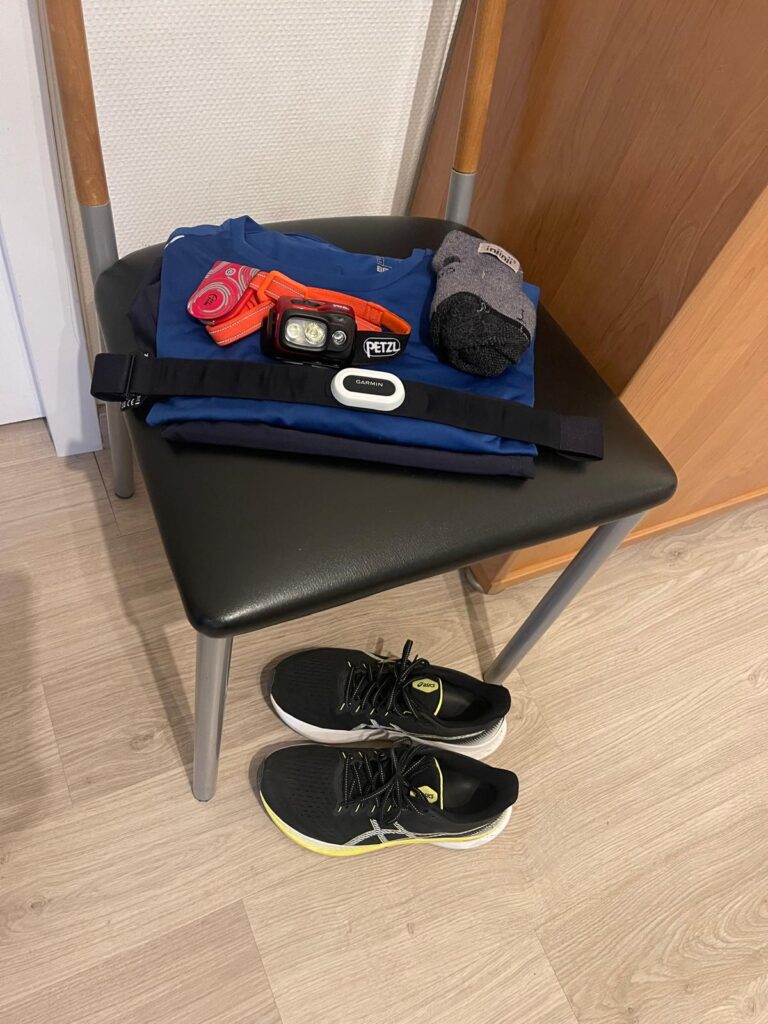
I prepare everything the night before – checking the weather forecast and laying out appropriate clothes accordingly, folding my gear on a chair with shoes neatly placed underneath. I wear my watch to bed so the alarm vibrates silently on my wrist. When that gentle buzz goes off, there’s no decision-making required. Just get dressed and go.
This isn’t just about logistics; it’s about mental energy. Every decision you have to make uses up willpower. By eliminating those micro-decisions the night before, you save your mental energy for the one choice that matters: walking out the door.
The silent vibrating alarm is particularly effective because it wakes you gently without disturbing your family’s sleep.

Use Triggers
Your brain loves patterns and associations. I’ve learned to use this to my advantage by creating triggers that signal “run mode.”
Gear Triggers: On weekends when I have more time, I put on my running clothes anyway and start doing other things around the house. The clothes serve as a constant reminder not to “forget” my long run – they keep the intention alive throughout the morning.
Weather Triggers: While most people see rain or cold as barriers, I’ve learned to reframe them as opportunities. A misty morning run feels like an adventure. A crisp winter session makes me feel tougher.
Mental Space Triggers: I intentionally don’t run with music or podcasts – I use this time to put my thoughts in order and stay present with my body’s signals. This quiet mental time often becomes one of the most valuable parts of the run.
Accountability Without Pressure
Most of my runs happen in the early morning, when everyone else is still asleep. But on weekends, my family often catches me coming home in my running gear after a long run. I usually do those long runs on trails in the forest, and I still take photos of the animals I encounter – rabbits, squirrels, foxes, deer, owls, even small eagles – to show them at home.
In the evenings, my kids will sometimes ask, “Did you run today?” or “Did you see an animal?” Not in a judgmental way, just with genuine curiosity. They’ve grown used to me running, and in their own way, they share in the routine.


That gentle accountability – knowing someone might ask about it later – is often enough to tip the scales on tougher days. Not because I feel pressured to prove anything, but because by making it visible, I’ve made it real.
Training for Life
On hard mornings—especially those dark winter ones when I didn’t sleep well, the weather is miserable, and the warm bed seems to hold me in its claws—I remind myself why I really do this.
Yes, it’s important to have small goals: training for a 5K, preparing for a marathon. But when I strip away all the noise, the deeper reason is clear: I run so I can still be there for my family even in old age. I want to stay capable, someone they can count on.
On those brutal winter mornings when everything in me wants to stay under the covers, that’s exactly when this training matters most—proving to myself that I can push through discomfort, that I’m building not just physical strength but the mental resilience I’ll need for whatever life throws at me.
This mindset reminds me of what Sally McRae writes about in Choose Strong – that strength isn’t just physical, it’s a daily choice to show up for yourself and the people who matter to you.
Tip: Create triggers that make running feel automatic. Lay out gear, use weather as part of the adventure, and find light accountability that supports rather than pressures.
Chapter Summary: | Simple mental tricks – 10-minute commitments, morning timing, triggers, and light accountability – can overcome motivation gaps when used consistently.
3. Strengthening the Mental Game Over Time
Running builds mental toughness in ways that go far beyond physical fitness. Every time you keep going when your mind wants to quit, you’re training more than your legs – you’re training your resilience.
Reframing Discomfort as Growth
As I mentioned in my mental game discussion, I learned to talk to myself differently when runs get hard. Instead of “This is terrible, I want to stop,” I try “This is the part where I get better.”
It’s not about toxic positivity or pretending everything is easy. It’s about reframing challenge as opportunity. Every difficult moment during a run is a chance to prove to yourself that you can do hard things. This concept is central to Jocko Willink’s philosophy in Extreme Ownership – taking responsibility for your situation and using adversity as fuel for growth.
This mental shift happened gradually. At first, it felt forced and fake. But over time, as I accumulated evidence of getting through tough runs, the reframe became genuine. Now when I hit a challenging section, part of me actually gets excited – because I know I’m about to grow stronger.

Focus Techniques When Your Mind Wants to Quit
Chunking: I break my runs into small sections, just like I described in my beginner’s guide. Instead of thinking “I have 3 kilometers left,” I think “just make it to that tree.” Then I pick another landmark. This makes even long distances feel manageable.
Breathing Focus: When my mind starts spiraling into “I can’t do this,” I focus on counting breaths instead. Four steps inhale, four steps exhale. It gives my mind something concrete to focus on instead of the discomfort.
Mindfulness Practice: Remember how I mentioned running without music or podcasts? This forced mindfulness became one of my greatest mental training tools. Focusing on my surroundings, my breathing, the rhythm of my feet – it’s like meditation in motion.
Small Wins That Compound
The mental skills you build during running show up everywhere else in life. That voice that says “just make it to the next tree” becomes the voice that says “just finish this project” or “just get through this difficult conversation.”
Running teaches you that you can do hard things, one step at a time. Every run completed when you didn’t feel like it is proof that you’re stronger than your excuses. That evidence accumulates and changes how you see yourself.
Jesse Itzler captures this perfectly in Living with a SEAL when he describes how pushing beyond his comfort zone in training translated to confidence in business and life. The mental resilience you build on the road carries over into every area of your existence.
Chapter Summary: | Mental toughness develops gradually through reframing challenges, using focus techniques, and accumulating evidence that you can do hard things.
4. What to Do When You Fall Off Track
Everyone skips runs. Everyone hits a rut where the habit feels broken and motivation has completely disappeared. I’ve been there multiple times – sometimes for a few days, sometimes for weeks.
The key is not letting a small break become a full stop.
My Restart Protocol
When I fall off track, I resist the urge to jump back in with grand plans and ambitious distances. This is where my run-walk method becomes invaluable again.
Instead of trying to pick up where I left off, I return to the basics: a short, easy run with no expectations. Just around the park, taking time to enjoy the views and savor the moment. No pressure to make up for lost time or prove anything to myself.
I remind myself of what I learned when I restarted running: every run is a fresh start. It doesn’t matter that I missed three days, or that my last run was terrible, or that I feel out of shape. What matters is that I’m moving forward again.

Avoiding the Guilt Spiral
The worst thing you can do is turn a temporary pause into a permanent story about failure. Your brain will try to make missing a few runs into evidence that “you’re not a runner” or “you don’t have discipline.”
That’s not true. You’re someone who runs, and sometimes takes breaks, and then starts running again. The pause doesn’t erase your identity or progress.
Sometimes I’ll go back to run-walk intervals even after months of continuous running. There’s no shame in scaling back to what works. Progress isn’t always linear, and that’s completely normal.
Tip: Treat restarts like new beginnings, not failures. Go back to basics without guilt.
Chapter Summary: | Setbacks are normal. Restart with low expectations, avoid guilt, and remember that scaling back often leads to moving forward stronger.
5. Beginner Running Motivation FAQ
Q: What if I miss a week of running?
A: One week off won’t hurt your fitness significantly. Just restart with shorter, easier runs and build back up gradually. What matters is getting back to it without overthinking. Remember: if you’ve built fitness before, you’ll get it back much faster after a break than someone starting from scratch. Your body remembers.
Q: How do I motivate myself to run in bad weather?
A: Reframe weather as part of the adventure. I’ve learned to love misty morning runs and feel tougher after running in cold weather. Good gear helps, but mindset matters more. Also remember: you’re never as cold or wet as you think you’ll be once you start moving.
Q: Is it okay to walk during a run when I don’t feel motivated?
A: Absolutely. Walking during a run isn’t failure – it’s smart training. The run-walk method I use proves this works. Some of my most enjoyable runs have included walking breaks when I needed them.
Q: How do I stay motivated long-term?
A: Stop trying to stay motivated. Build systems instead. Set up your gear the night before, run at consistent times, track small wins, and remember that motivation follows action. Focus on the habit, not the feeling.
Q: What if I feel silly running slowly?
A: Everyone starts somewhere. I promise you look more like a runner than you think. Most experienced runners respect beginners more than you know – we remember being where you are. Besides, running slowly builds your aerobic base better than trying to go fast too early. And here’s the truth: people who judge runners are people who don’t run themselves.
Q: How do I deal with negative self-talk during runs?
A: Practice reframing: instead of “I’m so slow,” try “I’m building my endurance.” Instead of “This is hard,” try “This is making me stronger.” It takes practice, but changing your internal dialogue changes your experience.
Chapter Summary: | Common beginner concerns about missed runs, weather, walking breaks, and self-doubt all have practical solutions focused on consistency over perfection.
6. Conclusion – Your Mental Toolkit Starts Now
Motivation will come and go – that’s not a bug in your system, it’s a feature of being human. But your mental toolkit can carry you through the days when feelings fail you.
The strategies in this guide aren’t theoretical. They’re battle-tested on early mornings when I didn’t want to get up, during stressful work periods when running felt impossible, and through weather that made staying inside seem like the smart choice.
Key Mindset Shifts:
- Action creates motivation, not the other way around
- Systems beat feelings every time
- Small commitments (10 minutes) often become bigger wins
- Setbacks are part of the process, not signs of failure
Your Challenge This Week: Try the 10-minute rule three times this week. On a day when you don’t feel like running, commit to just 10 minutes. See what happens. Even if you only do 10 minutes all three times, you’ll have maintained your habit and proven to yourself that you can show up regardless of how you feel.

Remember what I learned through my own running journey: the run you didn’t want to do is always the one you’re most proud of afterward.
If you’re still building your foundation, make sure you’ve read my complete beginner’s guide and step-by-step starting plan. These mental strategies work best when you have the basics in place.
Ready to build your mental running toolkit? Start with the 10-minute rule tomorrow morning – your future self will thank you.
Chapter Summary: | Consistency beats motivation. Use these mental tools to build a sustainable running habit that survives the ups and downs of real life.